
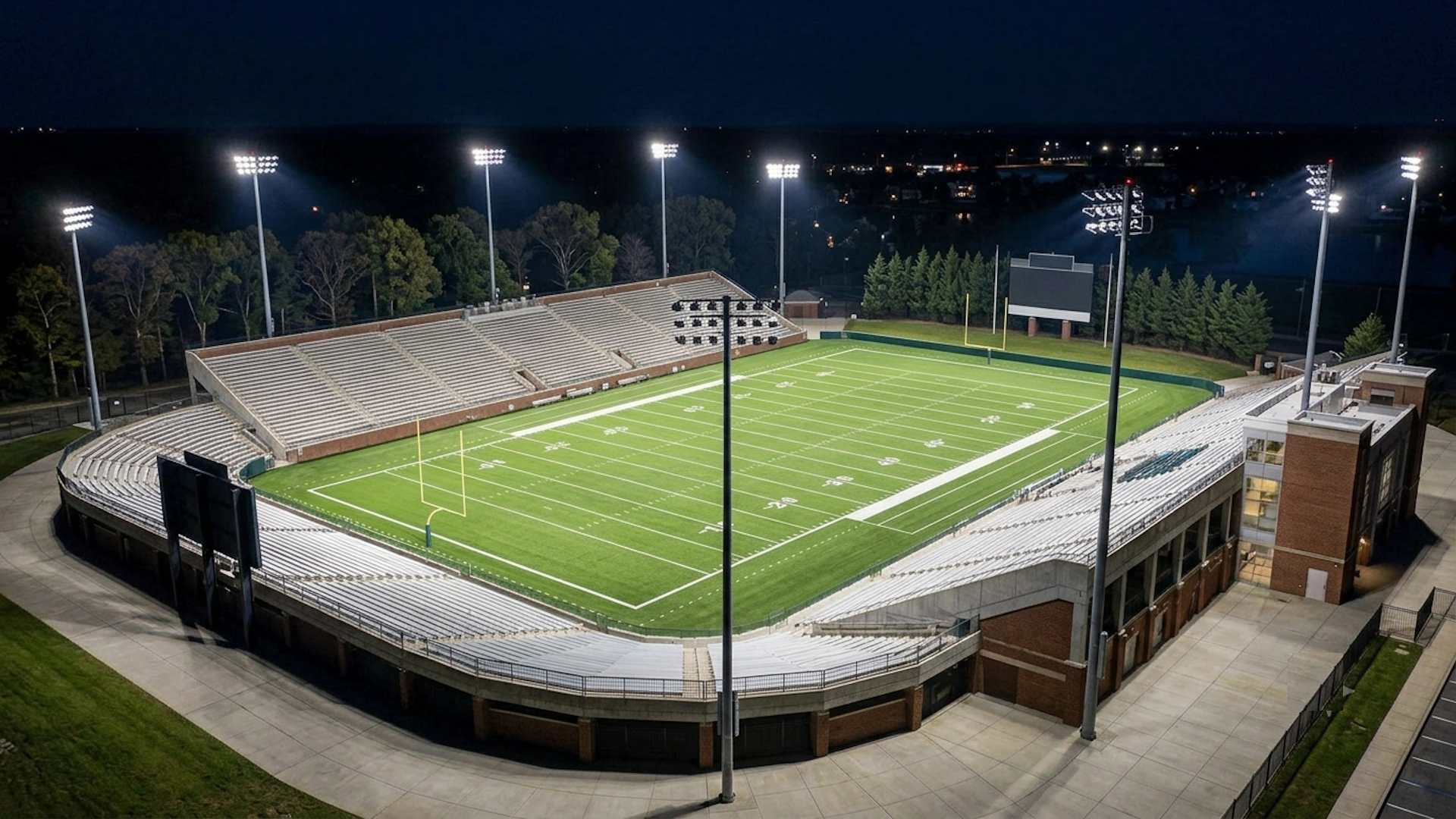
FOOTBALL FIELD LIGHTING • STADIUM LIGHTING • LED RETROFITS
Football Field & Stadium LED Lighting
Engineered LED sports lighting for high school fields, municipal athletic complexes, colleges, stadiums and multi-use facilities across Long Island, New York, Naples and Southwest Florida, and nationwide projects.
SPORTS LIGHTING BUILT AROUND THE FIELD
Football Stadium Lights Should Be Designed, Not Guessed
A football field is one of the worst places to choose fixtures from a catalog and hope the beam pattern works. The playing surface is large, the ball moves quickly through the air, players look in multiple directions, spectators view the field from different elevations, and tall mounting heights magnify every bad aiming decision. A football lighting project has to solve for visibility, uniformity, glare, spill light, pole locations, electrical capacity, controls and the way the facility is actually used.
Creative Lighting Solutions approaches football field LED lighting as a complete system. We can review existing poles and fixtures, discuss the level of play and event requirements, develop a project-specific lighting layout, evaluate LED retrofit opportunities and help the facility team understand the practical options before equipment is selected.
That matters whether the project is a Long Island high school replacing aging metal halide fixtures, a municipal sports complex adding evening field capacity, a private school or university planning an upgrade, or a Florida property evaluating a new athletic lighting system. The objective is not simply to make the field bright. The objective is to put the right light in the right place, with the right control, while avoiding unnecessary glare and wasted light.
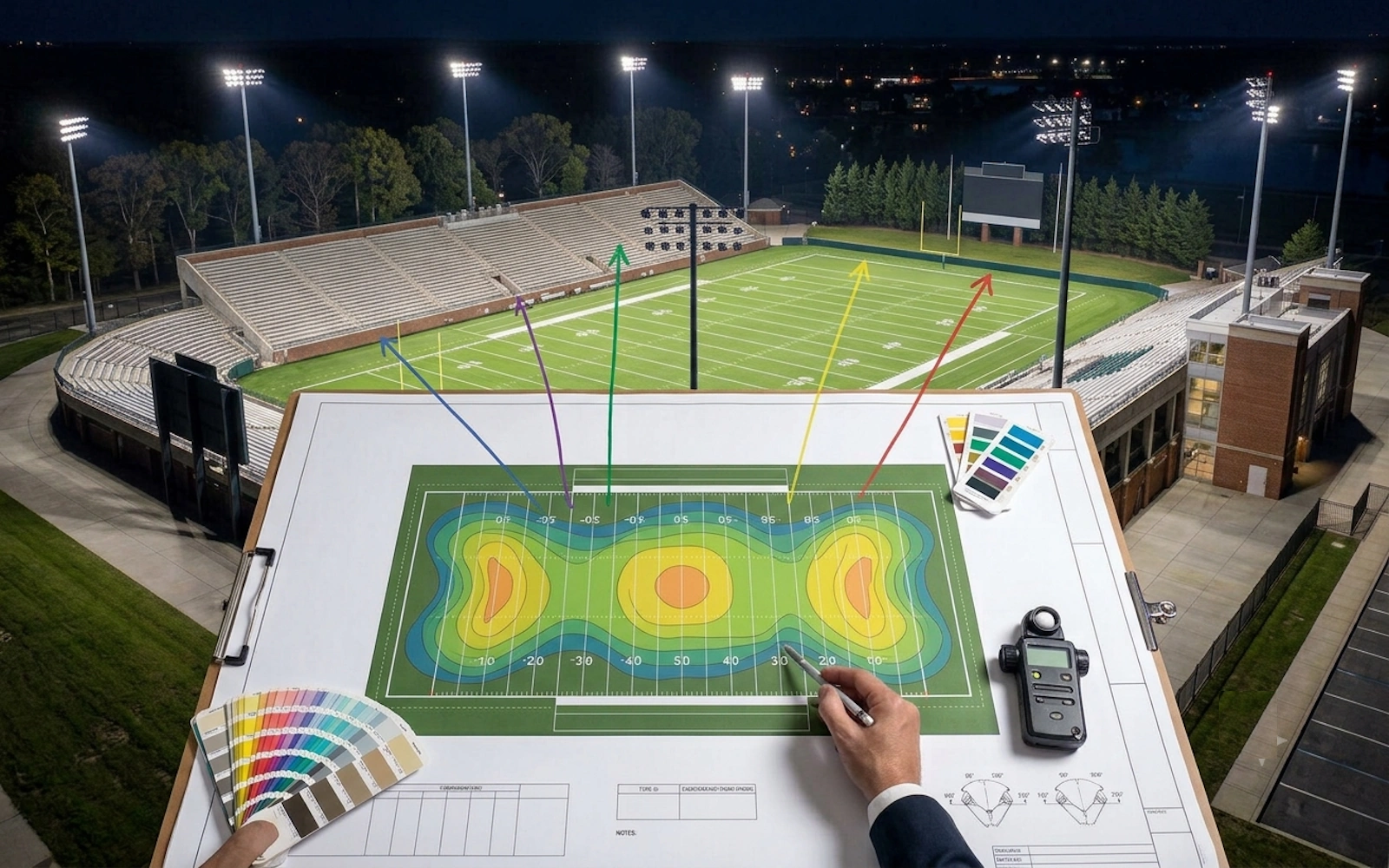
THE DESIGN PRIORITIES
What a High-Performance Football Lighting System Has to Get Right
The current IES recommended practice for sports and recreational lighting addresses the quality and quantity of illumination needed for participants and spectators. That is why football lighting cannot be reduced to one universal fixture count or one universal foot-candle number.
Uniform Field Coverage
Bright spots beside dark zones make the field harder to read. A photometric layout should evaluate how the entire playing surface is illuminated, not just the average output of the fixtures.
Glare Control
Players, officials and spectators should not be forced to look through uncontrolled high-angle brightness. Fixture optics, mounting height, pole position, shielding and aiming all influence glare.
Vertical Visibility
Football is not played on a flat diagram. The ball travels through the air, players move vertically and cameras view action from multiple positions. Vertical illumination can matter alongside light on the turf.
Spill-Light Management
Schools and municipal fields often sit near homes, roads or other properties. Careful optical control helps keep more useful light on the field and less unwanted light outside the playing area.
Controls & Scheduling
Modern LED systems can support instant on/off, dimming and scheduled operating modes. Facilities can use different light levels for practice, events, cleanup and other approved operating conditions.
Maintainability
Tall sports-lighting poles make every maintenance event more complicated. Fixture access, driver strategy, surge protection, product support and long-term serviceability belong in the project conversation.
Design reference: ANSI/IES RP-6-24, Lighting Sports and Recreational Areas.
FACILITIES WE SUPPORT
LED Football Lighting for Schools, Municipal Fields, Colleges and Stadiums
High School Football Fields
Upgrade aging field lights, improve visibility for night games and practices, evaluate existing poles and modernize controls without pretending every school needs a professional-stadium system.
Municipal Athletic Complexes
Lighting plans for public fields that may host football, soccer, lacrosse, community events and seasonal programming, with attention to scheduling and neighboring properties.
College & University Fields
Project planning for campus stadiums, practice fields and multi-use athletic facilities where performance, controls, event operations and spectator experience all matter.
Private & Multi-Use Facilities
Lighting for training facilities, private schools, clubs and sports campuses that need a professional field environment without wasting energy or over-lighting the site.
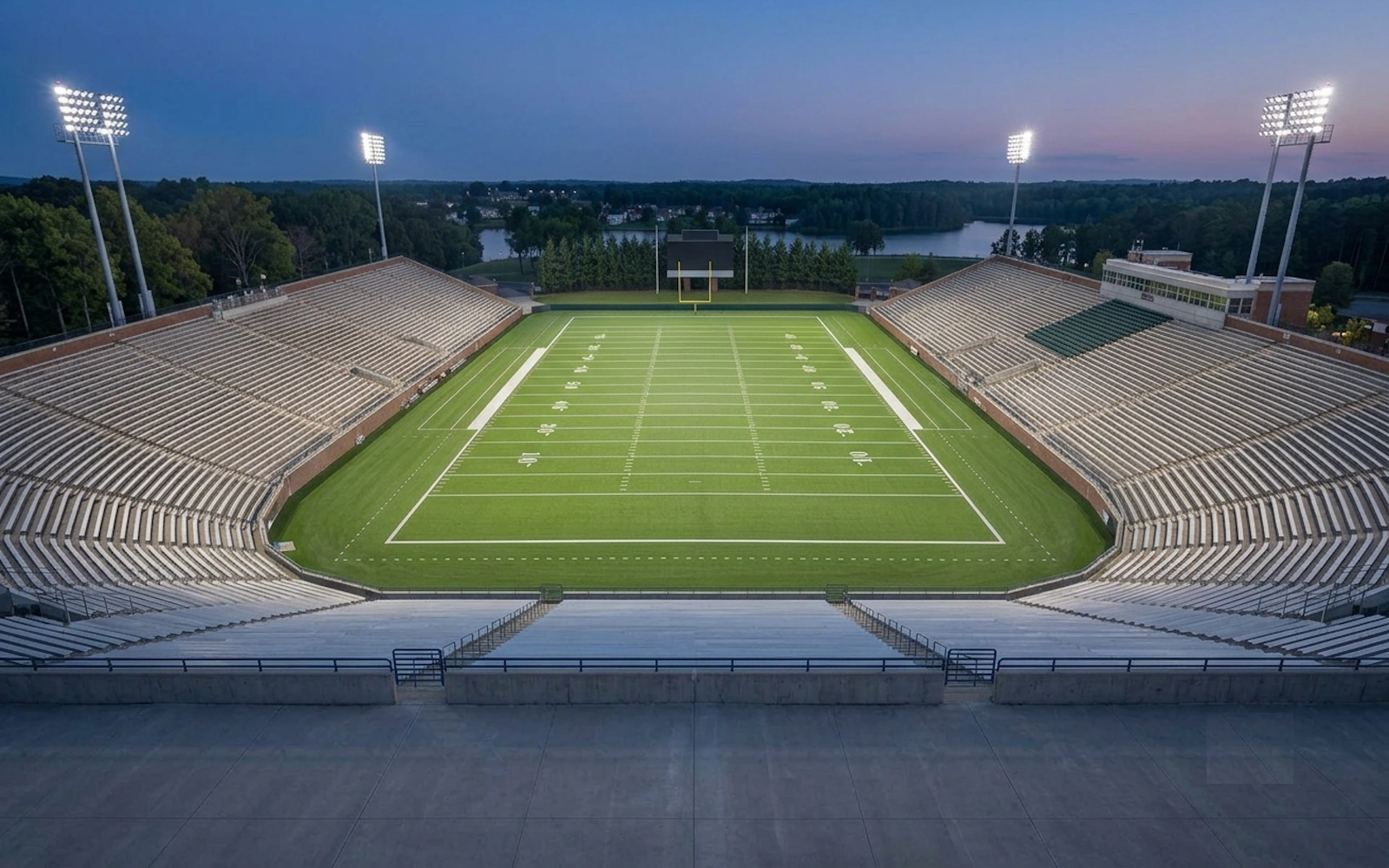
RETROFIT OR NEW SYSTEM?
Replacing Metal Halide Football Stadium Lights With LED
Many existing football fields were built around metal halide or other HID sports-lighting systems. The temptation is to compare fixture wattage, pick a lower-watt LED and call the retrofit complete. That shortcut can create poor distribution, dark zones, glare or a system that looks impressive from the parking lot but performs badly on the field.
A proper retrofit review starts with the existing system: pole count and location, mounting height, crossarm condition, fixture quantity, beam distribution, electrical service, switching and controls, field dimensions, neighboring properties and the facility’s current complaints. From there, the proposed LED system can be modeled against the actual field instead of against a generic replacement chart.
Existing poles may be reusable, but they should never be assumed reusable.
Some projects can retain poles or structural components; others require modification or replacement. Structural condition, loading, mounting hardware and the proposed fixture configuration have to be evaluated by the appropriate qualified professionals. Creative Lighting can coordinate the lighting side of the project and help make sure the proposed equipment and layout reflect the real site conditions.
LED technology also changes how a facility can operate the system. Unlike many legacy HID systems, LED luminaires can provide instant full output and are compatible with a range of control strategies. The U.S. Department of Energy specifically notes the value of controls such as dimming and advanced control systems for energy-efficient lighting.
FROM FIELD REVIEW TO LIGHTING PLAN
Our Football Field Lighting Process
1
Define the Facility
We start with location, field dimensions, sport usage, level of play, event schedule, existing system, known complaints and project goals.
2
Document Existing Conditions
Existing poles, mounting heights, fixture quantities, electrical conditions and site constraints are reviewed before the replacement concept is finalized.
3
Develop the Photometric Approach
Fixture output, optics, aiming and pole geometry are modeled to pursue appropriate coverage, uniformity and glare control for the project.
4
Review Controls & Operations
We discuss how the field is actually used: practices, games, cleanup, special events and periods when lower output or scheduled control may make sense.
5
Evaluate Energy & Incentive Options
For eligible Long Island projects, current PSEG Long Island commercial-efficiency requirements can be reviewed. Other utilities and states may offer different programs.
6
Plan the Upgrade
The facility receives a clearer path for fixture selection, system layout and project coordination instead of a pile of disconnected product specifications.
LONG ISLAND, NEW YORK
Football Field LED Lighting Across Nassau & Suffolk County
Creative Lighting Solutions is based in Plainview and supports commercial and sports-lighting projects throughout Long Island. Football lighting projects on Long Island can involve school districts, private schools, colleges, municipalities, parks departments, athletic organizations and private facility owners. The site conditions can vary dramatically from one field to the next, especially where older poles, nearby residences, roadways and mixed-use school campuses are involved.
For a Long Island field, our job is to help the facility understand what it has now, what is not working and what a properly designed LED system could change. That can include a full lighting redesign, a retrofit using portions of the existing infrastructure, improved controls, better optical distribution or a phased plan that accounts for budget and facility operations.
Creative Lighting is listed on the site as a PSEG Long Island Prime Efficiency Partner. For qualifying projects, we can help review current commercial-efficiency program information and explain potential next steps. Rebate availability, pre-approval requirements and incentive amounts can change, so eligibility should be verified against the current program before equipment is ordered or savings are promised.
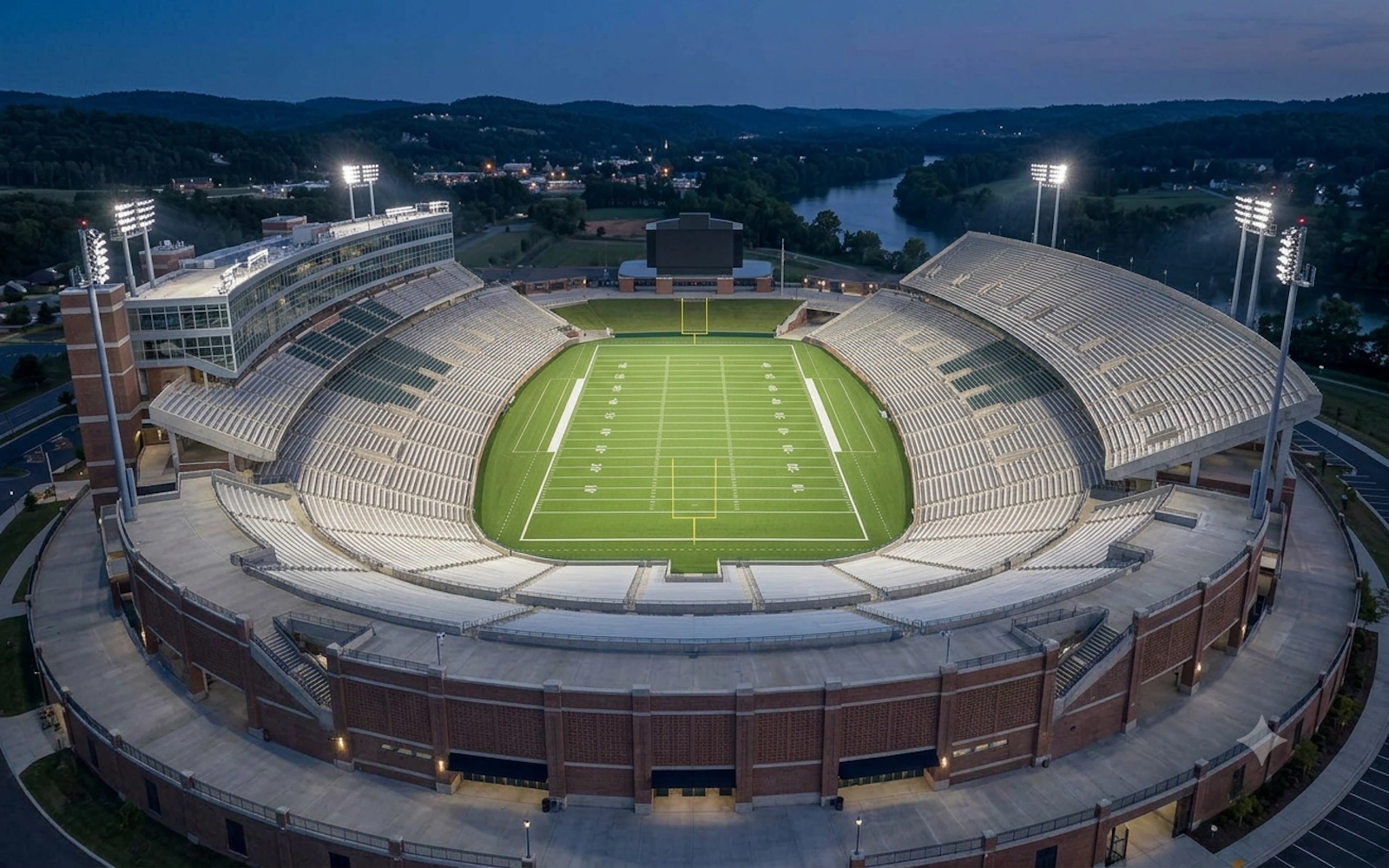
NAPLES & SOUTHWEST FLORIDA
Football Stadium Lighting for Naples, Florida & Regional Projects
Creative Lighting also supports projects in Florida, with Naples and Southwest Florida treated as an important growth market rather than a throwaway service-area sentence at the bottom of the page. Schools, private athletic facilities, municipalities, clubs and commercial property groups in the Naples area can use the same project-first approach: evaluate the field, define performance needs, model the lighting and select the system after the site requirements are understood.
Florida projects bring their own operating conditions. Outdoor equipment selection should account for the project environment, exposure, electrical requirements, mounting conditions and applicable local codes. Where a property is near residences or other sensitive areas, glare and spill-light control deserve attention early in the design, not after neighbors start calling.
Utility programs in Florida vary by provider and by measure. Creative Lighting should never advertise a blanket football-field rebate that may not exist for a specific outdoor project. Instead, the project team should verify the serving utility, current program and equipment eligibility. Florida Power & Light publishes current business energy-saving programs, but the exact applicability of any incentive has to be checked for the proposed project.
LIGHTING DESIGN DETAILS
The Metrics Behind Better Football Field Lighting
Illuminance
Light level is part of the design, but not the whole design. The required target depends on the facility, level of play, governing criteria and whether there are spectator or broadcast considerations.
Uniformity
The relationship between brighter and darker areas affects how consistently athletes and officials can see the field. Strong average readings do not excuse poor distribution.
Vertical Light
Vertical illumination can affect visibility of players and airborne objects and becomes increasingly important where spectators, video or broadcast cameras are part of the use case.
Color Quality
LED source selection can improve visual clarity and color appearance compared with many aging legacy systems. The right color characteristics depend on the project and event needs.
Glare & Cutoff
Good optics put useful light on the field while limiting uncomfortable brightness toward players, stands, roads and nearby properties.
Controls
Scheduling, dimming and zone control can let a facility use only the light it needs for the current activity instead of operating every fixture at full output for every task.
Additional technical reference: U.S. Department of Energy guidance on energy-efficient exterior lighting and controls.
PART OF A COMPLETE SPORTS-LIGHTING SYSTEM
One Football Page Should Strengthen the Entire Sports Lighting Cluster
Football stadium lights belong inside a broader sports-lighting authority structure. The page should link naturally to related facility and court pages, and those pages should link back where relevant. Search engines are not psychic, despite the industry’s occasional pricing model suggesting otherwise.
BEFORE YOU APPROVE A PROPOSAL
Questions Facility Owners Should Ask About Football Stadium Lights
✓
Was the system modeled for our actual field?
Ask for a project-specific photometric approach rather than a generic fixture replacement ratio.
✓
What happens to the existing poles?
Confirm whether poles, crossarms and mounting hardware are being retained, modified or replaced and who is responsible for structural review.
✓
How is glare being addressed?
Beam selection and aiming should consider players, spectators, roads and neighboring properties.
✓
What controls are included?
Determine whether the system supports practice levels, full-event output, scheduling, dimming or other operating modes.
✓
What is the electrical impact?
Verify voltage, service, switching, surge protection and any electrical modifications needed for the proposed system.
✓
What support exists after installation?
Warranty terms, replacement components, driver strategy and long-term product availability should be understood before purchase.
SPECIFICATION WITHOUT THE SALES MYTHS
How to Scope a Football Stadium Lighting Project Before Fixture Selection
A strong football lighting specification starts with the facility and performance requirements. Product wattage belongs later in the conversation. The following items should be documented before a final fixture schedule is approved.
Field & Event Use
Define whether the field is used for youth recreation, high school competition, college athletics, private training, public events or multiple sports. A practice field with limited spectators and a heavily attended stadium do not have the same visual or operating requirements.
Pole Geometry
Record the number of poles, pole setbacks, mounting heights, crossarm locations and aiming constraints. The same LED luminaire can perform very differently when the mounting geometry changes. Existing pole placement can also determine whether a retrofit is practical or whether the layout itself needs to change.
Field Dimensions & Obstructions
Measure the playing surface and identify bleachers, press boxes, scoreboards, tracks, fencing, trees, buildings and other site conditions that can affect aiming, access or the view from the field. A photometric model is only useful when it reflects the real site.
Electrical Conditions
Document available voltage, switching, panel capacity, conductor conditions and existing control equipment. Reducing connected lighting load can be valuable, but the new system still has to be compatible with the facility’s electrical infrastructure and operating plan.
Neighbors & Site Boundaries
Identify nearby homes, roads, parking areas and adjacent properties before aiming decisions are made. The lighting design should pursue useful illumination on the field while managing unnecessary light outside the intended area. Local requirements must be checked for the specific jurisdiction.
Camera & Spectator Needs
If games are streamed, recorded or broadcast, include camera positions and image-quality expectations in the early discussion. A field that appears acceptable to the eye can still produce poor video if vertical illumination, flicker performance or color quality is not appropriate for the application.
NEW CONSTRUCTION & EXPANSION
Planning New Football Field Lights Before the Poles Go Up
New-construction projects create an opportunity that retrofits do not: the lighting team can influence pole locations, mounting heights, electrical pathways and controls before those decisions become expensive to change. That makes early lighting design especially valuable for new schools, athletic complexes, campus expansions and private sports facilities.
Instead of selecting poles first and forcing the lighting system to work around them later, the project team can coordinate the field layout, spectator areas, track, scoreboard, property boundaries and anticipated event use. The photometric model can then inform the proposed pole geometry and fixture configuration. This is also the right stage to discuss future flexibility, such as additional sports, field reorientation, streaming or broadcast plans, and different operating modes.
For a multi-field complex, the design should also consider how multiple fields operate together. Parking areas, walkways and adjacent courts may need separate lighting zones. Controls should make it possible to light only the areas in use rather than turning on an entire property for one practice. The football page should therefore connect naturally to Creative Lighting’s broader sports facility LED lighting and parking lot lighting services.
LIFECYCLE THINKING
Buy the Lighting System, Not Just the Lowest Fixture Price
Sports lighting is installed high in the air, often above occupied fields and hard-to-access areas. The purchase decision should include more than the initial fixture price. A lower equipment number can lose its appeal quickly if the design requires more fixtures, produces poor field performance, creates complaints, lacks useful controls or forces repeated lift rentals and service calls.
Facility owners should compare system-level factors: photometric performance, optical options, surge protection, control compatibility, driver and component strategy, warranty details, manufacturer support, expected maintenance procedures and the availability of replacement components. The goal is not to buy the most expensive product. It is to avoid treating a long-term infrastructure project like a box of interchangeable lamps.
DOE guidance emphasizes that high-efficiency exterior lighting can gain additional energy and operating benefits from advanced controls. For sports facilities, this matters because fields are event-driven loads. A system that can be scheduled, dimmed or divided into operating zones may give a school or municipality more control over how and when energy is used.
FOOTBALL STADIUM LIGHTING FAQ
Frequently Asked Questions
How much does LED football field lighting cost?
There is no responsible one-price answer. Cost depends on field size, level of play, existing poles and electrical infrastructure, fixture quantity, mounting height, control requirements, structural work and whether the project is a retrofit or new installation. A site-specific review is the proper starting point.
How many LED lights does a football field need?
Fixture count should come from the field layout and photometric design, not from a generic rule. Pole positions, mounting heights, luminaire output, beam distributions, aiming, uniformity goals and glare constraints all affect the final quantity.
Can LED fixtures replace existing metal halide stadium lights?
Often, yes, but the retrofit should be engineered around the existing field and infrastructure. A one-for-one wattage comparison does not confirm that the LED system will provide the desired coverage or glare control.
Can we reuse our existing sports-lighting poles?
Some projects can retain existing poles and some cannot. Pole condition, structural capacity, mounting configuration and the proposed fixture loads must be evaluated by the appropriate qualified professionals before reuse is approved.
Do LED stadium lights turn on instantly?
LED systems can provide instant illumination without the long warm-up and restrike behavior associated with many legacy HID systems. That can make scheduling and multiple operating modes much more practical.
Can football field lights be dimmed for practice?
Many modern LED systems can be designed with dimming or multiple control levels. The exact control package should be selected for the facility’s operating schedule and approved lighting needs.
How do you reduce glare from football stadium lights?
Glare control involves the entire optical and site design: fixture selection, beam spread, shielding where applicable, mounting height, pole location and aiming. It is far easier to address in the design phase than after installation.
What lighting standard applies to football fields?
ANSI/IES RP-6-24 is the current IES recommended practice covering sports and recreational area lighting. Specific project targets can also be affected by the level of play, governing organizations, local requirements and broadcast or event needs.
Does Creative Lighting handle Long Island football field projects?
Yes. Creative Lighting Solutions is based in Plainview, New York and supports projects across Nassau County, Suffolk County and the greater Long Island market, including schools, municipal facilities, private athletic sites and other commercial properties.
Are PSEG Long Island rebates available for football lighting?
Potential incentive eligibility depends on the current PSEG Long Island commercial-efficiency program, existing equipment, proposed measures and project requirements. Creative Lighting can help review current options, but no rebate amount or approval should be guaranteed in advance.
Does Creative Lighting work on football stadium lighting in Naples, Florida?
Creative Lighting supports Florida and nationwide commercial lighting projects, with Naples and Southwest Florida included as priority service markets. Project scope and local requirements should be reviewed before equipment is selected.
Can you design lighting for a multi-use football and soccer field?
Yes. Multi-use facilities should be designed around every intended sport and operating mode. The lighting plan needs to account for field orientation, targets, practice and competition needs, spectator positions and control requirements.
START WITH A PROJECT REVIEW
Plan Your Football Field or Stadium LED Lighting Upgrade
Tell Creative Lighting about the field, existing lights, pole configuration, location and project goals. We can help you move from “the field is too dark” or “these old lights cost too much to maintain” to a project-specific lighting plan built around the facility.