
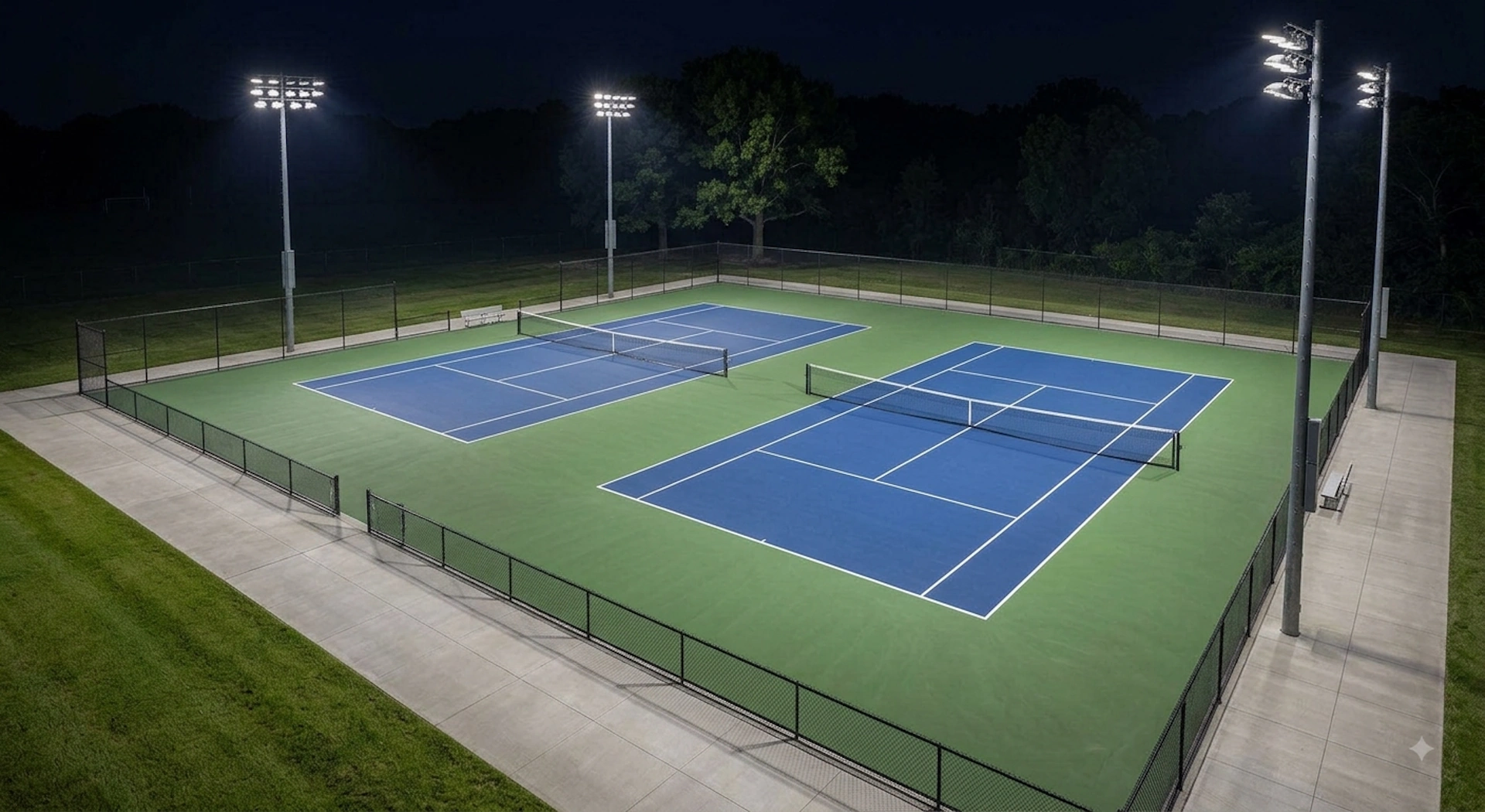
LED Tennis Court Lights for Long Island, NY & Naples, FL
Purpose-built tennis court lighting for clubs, schools, municipalities, communities, hospitality properties and private facilities. Creative Lighting plans LED systems around visibility, uniformity, glare control, pole locations, operating needs and the way the courts are actually used.
- Project-specific lighting layouts and fixture selection
- New LED tennis court lighting and legacy HID retrofit planning
- Serving Long Island, New York, Florida and nationwide projects
Tennis Court Lighting Is a Design Problem Before It Is a Fixture Problem
A tennis court can be bright and still be difficult to play on. The real objective is controlled, consistent light that helps players track a fast-moving ball without harsh hot spots, distracting shadows or glare in common sight lines.
Creative Lighting approaches tennis court LED lighting as a complete system. That means looking at court orientation, pole quantity and position, mounting height, fixture optics, aiming, surrounding properties, court count, player level and the hours the facility expects to operate. Existing facilities may also require a practical review of poles, electrical infrastructure and legacy metal-halide or other HID equipment before a retrofit recommendation makes sense.
For Long Island facilities, the project may involve a private club in Nassau County, a municipal recreation complex, a school or university, a residential community or an established tennis center looking to reduce maintenance and improve nighttime play. In Southwest Florida, the same planning discipline matters for country clubs, HOAs, resorts and communities around Naples, Bonita Springs, Estero and Fort Myers, where outdoor courts often operate deep into the evening.
The result should not merely photograph well from the parking lot. It should work from the baseline, at the net, on overheads, during serves and while a player is tracking the ball across different zones of the court.
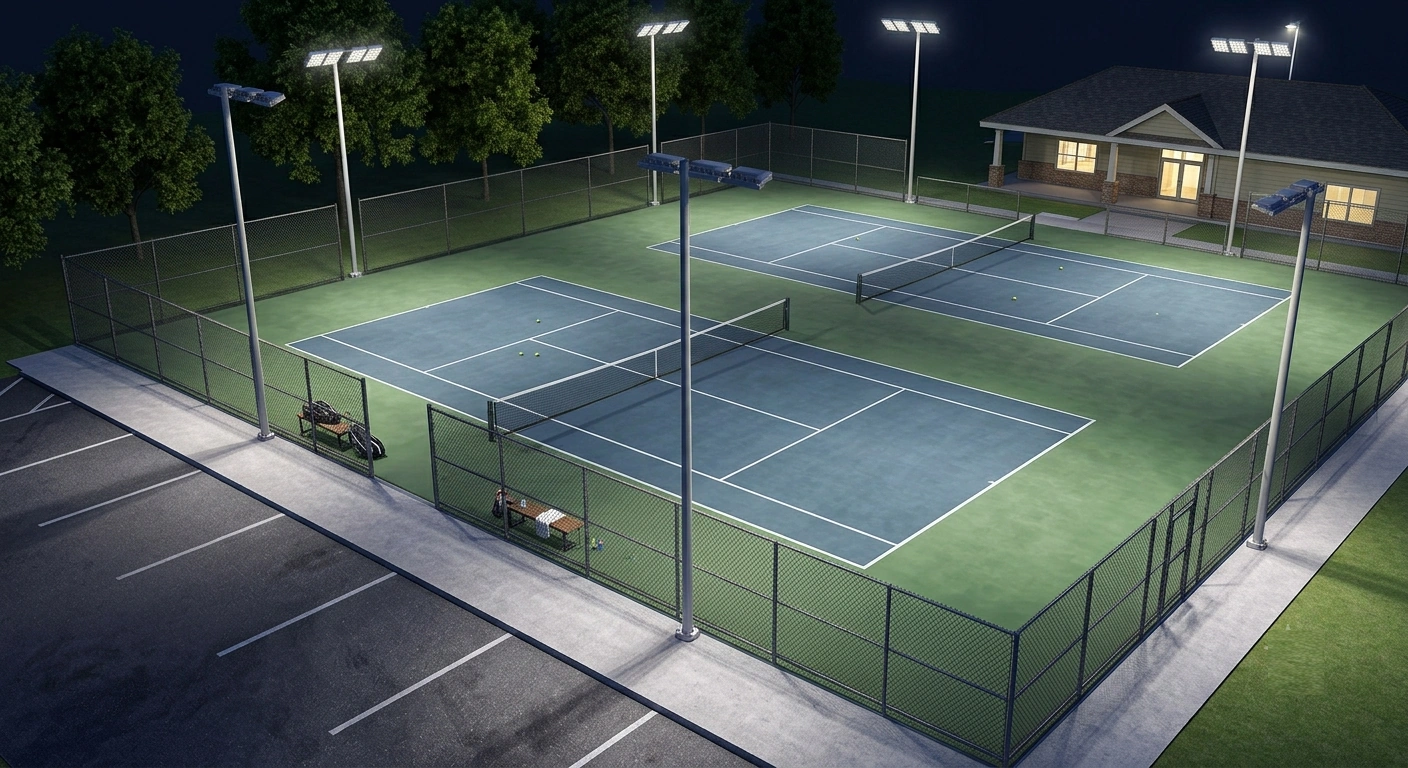
What a Strong LED Tennis Court Lighting Plan Has to Solve
Good sports lighting is about relationships between light levels, distribution, aiming and the surrounding environment. Throwing more lumens at the court is the expensive version of guessing.
Uniformity Across the Court
Players move from baseline to service box to net in seconds. A thoughtful layout aims to avoid abrupt bright and dark zones that make ball tracking less comfortable and can make the facility feel visually uneven.
Glare Control
Fixture optics, pole location and aiming all matter because players routinely look upward during serves, lobs and overheads. The system should put useful light on the playing surface without turning every high ball into an argument with the fixtures.
Vertical Visibility
Tennis is not played on the pavement. The ball travels through three-dimensional space. The design has to support visibility of the ball in flight, not simply achieve an attractive horizontal reading at court level.
Spill-Light Management
Courts near homes, roads, parking areas or other amenities need controlled distribution. Careful optics and aiming can help reduce unwanted light beyond the intended playing area while still supporting usable court illumination.
Reliable LED Performance
Sports fixtures need to match the application, environment and operating schedule. Equipment selection should consider performance, thermal conditions, controls, serviceability and the requirements of the specific project.
Controls & Operating Strategy
Scheduling, zoning and appropriate control strategies can help a facility operate courts only when needed, support different use patterns and avoid treating a six-court complex like one giant on/off switch.
Planning a tennis court retrofit or a new facility?
Start with the court, pole conditions, electrical infrastructure and desired level of play. Then select the lighting system. Reversing that order is how facilities end up buying expensive fixtures twice.
LED Tennis Court Lighting for Long Island Clubs, Schools & Communities
Creative Lighting is based in Plainview and supports commercial lighting projects throughout Long Island. Tennis facilities here range from single private courts to multi-court clubs, school campuses, municipal parks and community associations. Those projects can have very different constraints even when the court dimensions look similar on paper.
An older Long Island tennis facility may be working around legacy poles and metal-halide fixtures that take time to reach full output, consume significant power and create a recurring lamp-and-ballast maintenance cycle. A modern LED project can be evaluated as a retrofit around usable existing infrastructure or as a more comprehensive redesign when pole locations, aiming or electrical conditions limit the desired result.
For new projects, photometric planning helps the owner understand intended coverage before fixtures are installed. For existing facilities, the review should identify what can responsibly stay, what needs to change and whether the current system is capable of supporting the target lighting performance.
Qualifying Long Island commercial projects may also have current energy-efficiency incentive opportunities. Eligibility changes with program rules and project details, so Creative Lighting reviews rebate possibilities rather than advertising a fictional one-size-fits-all dollar figure. The company’s current site identifies Creative Lighting as a PSEG Long Island partner and provides a dedicated commercial rebate review process.
Tennis Court LED Lighting in Naples, Florida & Surrounding Communities
Naples has exactly the kinds of properties where well-planned tennis lighting matters: country clubs, residential communities, hospitality properties, private facilities and multi-court recreation environments with demanding users and nearby neighbors.
Creative Lighting supports Florida projects without pretending that a Plainview company suddenly acquired a fictional office beside the Gulf. The page should state the service model clearly: New York-based expertise with project support in Florida and other locations nationwide.
For Naples-area outdoor courts, equipment and design decisions should reflect the actual site environment. Heat, humidity, weather exposure, coastal conditions, operating hours and proximity to residences can all influence fixture specification, aiming, controls and installation details. The right answer for a protected indoor training space is not automatically the right answer for an exposed outdoor club complex.
Project coverage can naturally extend through Naples, Bonita Springs, Estero and Fort Myers when Creative Lighting is supporting suitable commercial, hospitality, club, community or institutional work. Each project still begins with the physical site, use case and desired lighting result, not a generic “Florida package.”
Two Different Tennis Lighting Projects, Two Different Starting Points
| Project Type | What We Review | Typical Decision Points |
|---|---|---|
| Existing HID / Metal-Halide Retrofit | Current poles, mounting, wiring, controls, fixture condition, distribution and maintenance history. | Reuse vs. replace poles, LED fixture optics, aiming, electrical compatibility, controls and whether the existing geometry can deliver the desired result. |
| New Tennis Court Lighting | Court count and orientation, intended use, neighboring properties, pole locations, electrical service and performance objectives. | Pole plan, mounting heights, fixture quantities, optical distribution, aiming, controls, spill-light strategy and future service access. |
| Multi-Court Complex Upgrade | Court-by-court conditions, shared poles, programming schedule, zones and the need to phase construction. | Zoned controls, project phasing, consistency across courts, electrical capacity, user disruption and long-term operating strategy. |
A retrofit can be an excellent solution when the existing infrastructure is sound and the geometry supports the performance objective. It can also be the wrong solution when aging poles, poor locations or an obsolete layout lock the new fixtures into the same problems as the old system. Creative Lighting’s job is to distinguish between those situations before equipment is ordered.
Our Tennis Court Lighting Design Process
Review the Facility and Use Case
We start with court count, location, operating schedule, level of play, existing equipment, adjacent properties and what the owner wants the new system to accomplish.
Document Existing Infrastructure
For retrofit projects, poles, electrical conditions, fixtures and controls need to be understood. Keeping usable infrastructure can be efficient. Assuming everything is usable because it is still standing is not engineering.
Develop the Lighting Approach
Fixture type, optics, mounting, aiming and controls are selected around the site. Photometric modeling can help evaluate distribution and identify problems before field installation.
Review Project and Rebate Considerations
Long Island projects can be reviewed for applicable PSEG Long Island commercial incentive opportunities. Other locations may have different utility or program requirements.
Coordinate Installation and Final Aiming
Sports lighting performance depends on execution. Fixture placement and aiming should reflect the designed layout, followed by field review and adjustment when necessary.
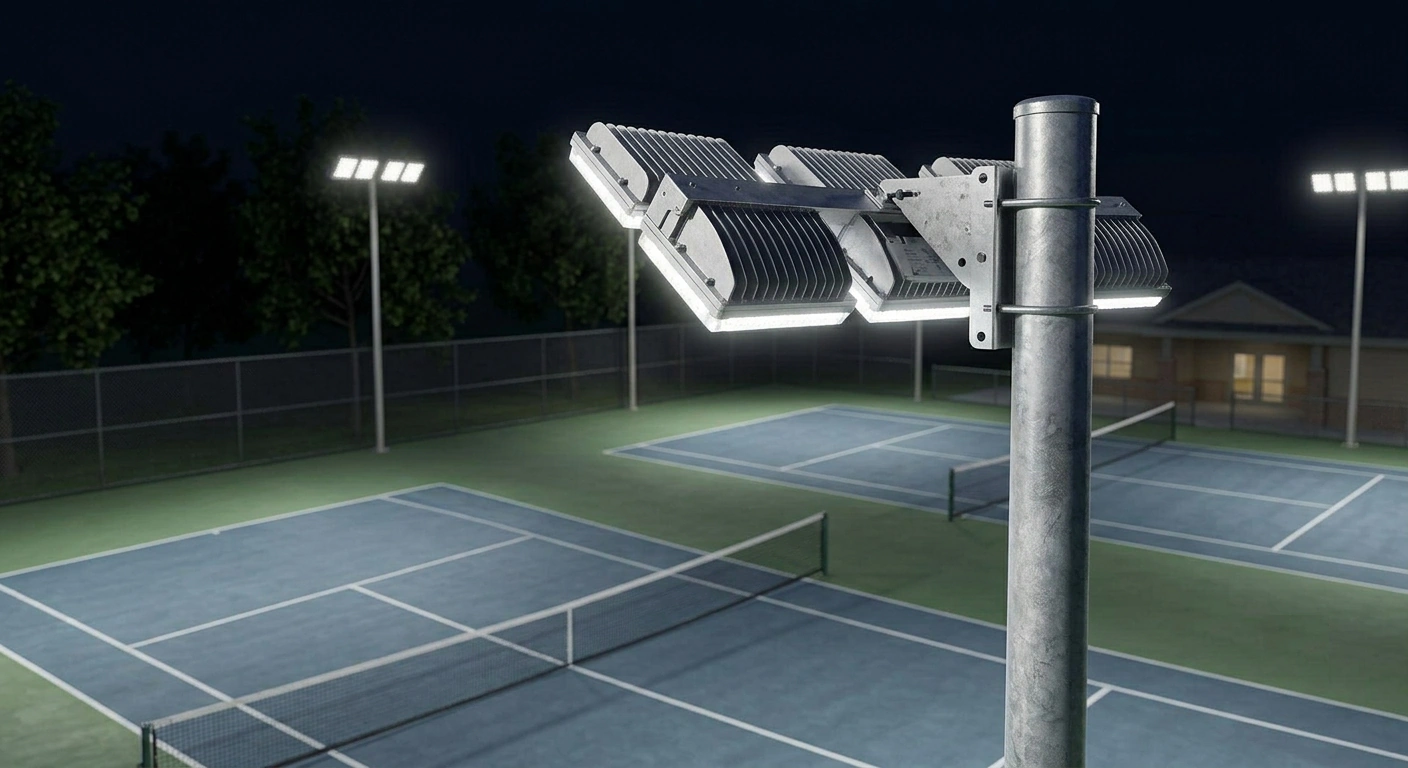
LED Tennis Court Lights for Commercial, Institutional & Community Properties
Tennis & Racquet Clubs
Single- and multi-court facilities that need dependable nighttime play, thoughtful zoning and a system appropriate for member programming.
Schools & Universities
Campus facilities balancing practices, matches, community use, maintenance access and surrounding site conditions.
Municipal Parks
Public courts where operating schedules, controls, neighboring properties and long-term maintenance can be as important as initial fixture cost.
HOAs & Communities
Residential amenities where player experience must be balanced with responsible glare and spill-light control around nearby homes.
Country Clubs
Premium recreational properties where court lighting contributes to both playability and the overall nighttime appearance of the facility.
Hotels & Resorts
Hospitality facilities that may need court lighting integrated into broader exterior, pathway and property lighting strategies.
Private Court Facilities
Purpose-built systems for qualifying private or estate projects where the design can be developed around the exact site from the beginning.
Multi-Sport Complexes
Tennis lighting coordinated with adjacent pickleball courts, fields, parking, pedestrian areas and facility-wide controls.
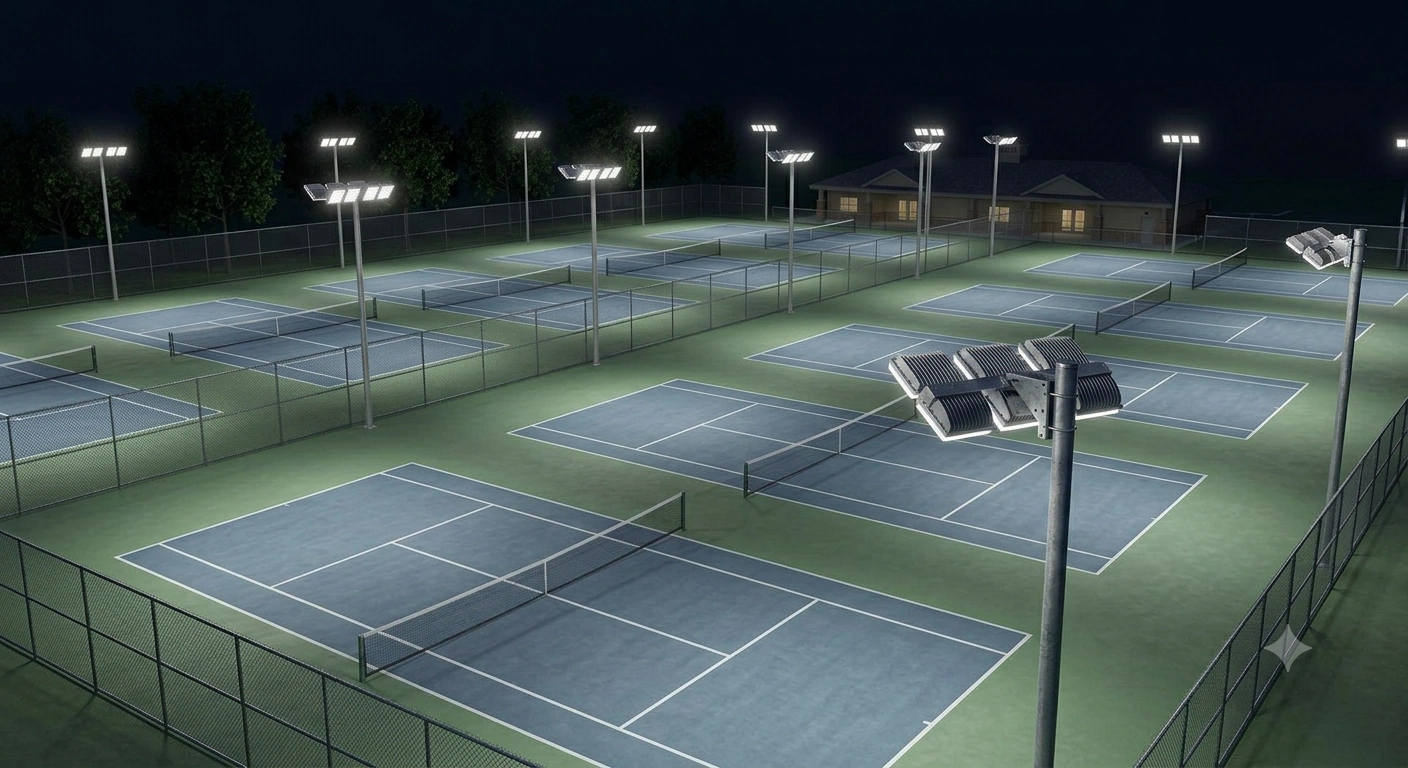
Tennis Courts Rarely Exist in Isolation
Many facility owners are not upgrading one court in a vacuum. The tennis courts may sit beside pickleball, a stadium field, parking areas, walkways, a clubhouse or other commercial spaces. That is where a broader lighting plan becomes useful.
Creative Lighting can evaluate the tennis application as part of a larger sports facility LED lighting project, coordinate adjacent pickleball court lighting, and connect the exterior work to broader commercial LED lighting needs. Facilities planning new construction or a major site upgrade can also use commercial lighting design and lighting consultation services to address the property as one operating environment.
This matters operationally. Separate lighting systems installed at different times can create mismatched controls, inconsistent color appearance, confusing maintenance requirements and electrical decisions that do not account for future expansion. A coordinated approach gives the owner a chance to think beyond the immediate fixture replacement.
For a tennis-only project, the scope can stay focused. For a larger club, school, municipality or hospitality property, the tennis courts can become one deliberate component of a site-wide LED strategy.
The Court Is Standardized. The Lighting Site Is Not.
Two tennis courts can have identical playing dimensions and still require very different lighting strategies. The variables outside the painted lines are where many projects succeed or fail.
Pole Geometry & Mounting Height
Existing pole locations often determine how much flexibility a retrofit really has. Poles that are too close to common player sight lines, spaced poorly across multiple courts or mounted at heights that limit effective aiming can create compromises even with excellent LED fixtures. A retrofit review should therefore treat the pole plan as part of the optical system, not as scenery that happens to be nearby.
Fixture Optics & Aiming
Sports fixtures can distribute light in very different patterns. The useful question is not which fixture has the biggest lumen number. It is which optical distribution places controlled light where the design needs it from the available mounting positions. Aiming then has to match the photometric plan in the field. Small changes in orientation can materially affect glare, hot spots and spill beyond the court.
Shared Poles on Multi-Court Sites
Four-, six- and eight-court facilities frequently use shared pole locations. That creates efficiencies, but it also means one pole can influence several playing surfaces and multiple viewing directions. The design should evaluate the whole complex together so one court is not improved at the expense of the court beside it.
Surrounding Homes & Property Lines
Residential communities, country clubs and municipal parks often place courts near homes, roads, walking paths or other amenities. Those surroundings have to be considered during fixture selection and aiming. Better control can reduce unnecessary light outside the playing area, but responsible results come from the full layout rather than from adding a shield after complaints begin.
Court Scheduling & Controls
A busy racquet facility may have six courts but only use two during late evening hours. Appropriate zoning and controls can let management operate the space more intelligently, reduce unnecessary runtime and simplify staff procedures. For new systems, controls should be discussed during design, not treated as an electrical afterthought once every circuit is already assigned.
Maintenance & Service Access
LED technology can reduce the routine lamp replacement associated with legacy HID systems, but no outdoor fixture should be treated as immortal. Pole access, driver or component serviceability, surge protection strategy, environmental exposure and the ability to maintain aiming are practical considerations for an owner who expects the system to perform for years.
Why Photometric Planning Belongs Before the Purchase Order
A photometric layout gives the project team a model of how a proposed fixture arrangement is expected to distribute light across the defined calculation area. It does not replace field verification, and a pretty rendering does not excuse bad installation. What it does provide is a disciplined way to compare fixture quantities, optics, pole positions and aiming before crews are in lifts and the equipment is already paid for.
For an existing Long Island club, the model can help answer whether the present pole system is worth retaining and how a proposed LED retrofit is likely to behave. For a Naples-area new construction project, it can help establish the pole and fixture plan while there is still time to coordinate electrical work, landscaping, neighboring uses and site design. In both cases, the value is the same: important decisions are made while they are still relatively cheap to change.
Creative Lighting can use this design-first approach as part of a focused tennis project or as one piece of a broader sports-facility lighting plan. That gives owners a more defensible basis for comparing proposals than fixture wattage, sales literature and whatever number happens to be boldest on a competitor’s quote.
Use Recognized Tennis & Lighting Resources When Planning the Project
Lighting targets depend on facility type, competition level and project requirements. Rather than invent a universal foot-candle number for every tennis court on the internet, we recommend matching the design to the governing criteria for the specific facility.
USTA Tennis Venue Services
The USTA provides facility assistance for projects that can include tennis court construction, resurfacing and lighting upgrades. Owners planning substantial facility work can review its current venue resources.
DesignLights Consortium
The DLC maintains qualified product lists and technical requirements for high-performing commercial LED equipment, including outdoor sports-lighting product categories.
PSEG Long Island
Commercial energy-efficiency programs and eligibility can change. Long Island owners considering a qualifying upgrade should confirm current requirements rather than relying on an old rebate chart.
LED Tennis Court Lighting FAQs
What makes tennis court lighting different from ordinary exterior lighting?
Tennis requires players to track a small, fast-moving ball through the air while frequently looking upward during serves, lobs and overheads. A useful design therefore considers distribution, vertical visibility, uniformity, glare, pole geometry and aiming rather than simply choosing a high-output floodlight.
Can existing metal-halide tennis court lights be converted to LED?
Often, but the right approach depends on the existing poles, fixture locations, electrical system and desired performance. Some facilities can use existing infrastructure effectively; others need changes to correct poor geometry or aging equipment. A site review should come before a retrofit equipment order.
How many LED fixtures does a tennis court need?
There is no responsible universal fixture count. Court configuration, pole quantity and height, fixture photometrics, optics, aiming, target performance, adjacent properties and whether courts share poles all affect the design. Photometric planning is the better way to determine quantity.
How bright should tennis court lights be?
The appropriate target depends on the facility and level of play, including recreational, club, scholastic or competition requirements. Creative Lighting can design around applicable criteria for the project instead of applying one generic light level to every court.
Can LED tennis lights reduce glare?
A properly selected and aimed LED system can give designers much more control over where light is delivered. Glare performance still depends on optics, fixture location, mounting height, aiming and court geometry. LED technology does not cancel poor design.
Can tennis court lighting be dimmed or controlled by court?
Many modern commercial LED systems can support scheduling, zoning or dimming strategies depending on the selected equipment and controls. For multi-court facilities, court-by-court or grouped control can help align operation with actual use.
Does Creative Lighting serve tennis facilities outside Long Island?
Yes. Creative Lighting is based in Plainview, New York and supports commercial lighting projects in Florida and other locations nationwide. Naples and surrounding Southwest Florida communities are priority project areas for suitable tennis, club, hospitality and community lighting work.
Do you install tennis court lights in Naples, Florida?
Creative Lighting supports Florida commercial lighting projects, including suitable tennis court lighting work in Naples and surrounding areas. The project scope, site conditions and installation logistics should be reviewed directly with the team.
Are PSEG Long Island rebates available for tennis court LED lighting?
Potential incentives depend on the current commercial program, equipment, customer eligibility and project details. Creative Lighting can review Long Island projects for applicable opportunities, but rebate approval and amounts should never be presented as guaranteed.
Should we replace tennis court poles during an LED upgrade?
Not automatically. Existing poles should be evaluated for condition, location, height and suitability for the proposed equipment. Retaining sound infrastructure can make sense, while preserving poor pole geometry can limit the new system before it is switched on.
Can a tennis lighting project be coordinated with pickleball or other sports lighting?
Yes. Creative Lighting also supports sports-facility and pickleball lighting. For shared properties, a coordinated design can address tennis, pickleball, fields, parking and related exterior lighting with a more consistent control and maintenance strategy.
What is the first step for a tennis court lighting project?
Contact Creative Lighting with the site location, number of courts, whether the project is new construction or a retrofit, and any known information about existing poles or fixtures. The team can then determine the appropriate review, consultation or lighting-design next step.
Plan the Tennis Court Lighting Before You Buy the Fixtures
Speak with Creative Lighting about a Long Island tennis club, school, municipal facility, Naples-area community, resort or other commercial court project. We can review the site, existing equipment and performance goals and help define the right LED lighting approach.
Creative Lighting Solutions • CLF Sales Inc. • 23 East Mall, Plainview, NY 11803